About the poster
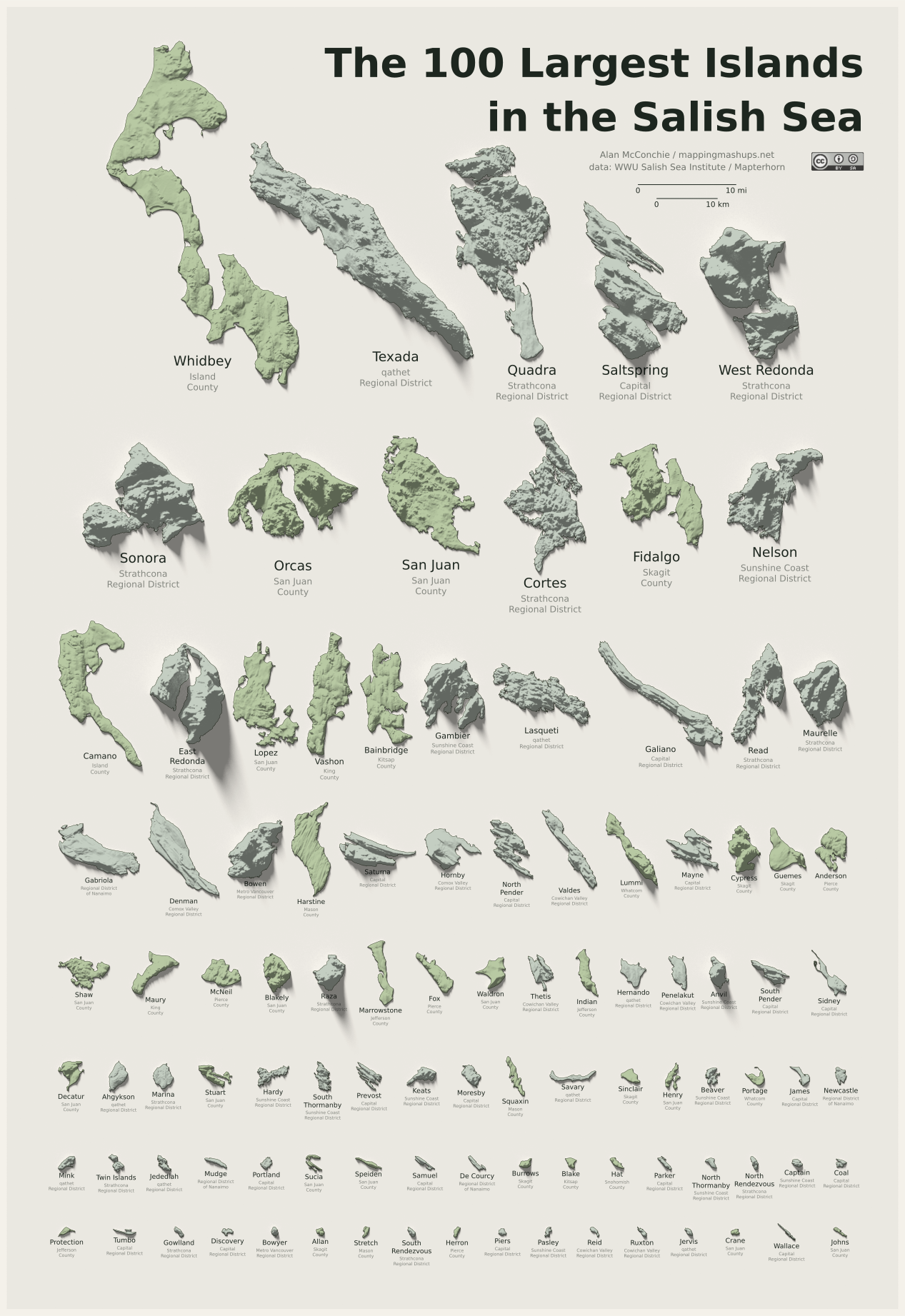
The Salish Sea is the inland sea shared by Washington State and British Columbia, encompassing Puget Sound, the Strait of Georgia, and the Strait of Juan de Fuca. It contains hundreds of islands; this poster shows the 100 largest by area, each rendered at the same map scale so their relative sizes are immediately apparent.
Islands are drawn in their north-up orientation and arranged in reading order, largest to smallest, left to right. US islands are shown in a warmer green; Canadian islands in a cooler grey-green.
Excludes islands partially in the Salish Sea (like Vancouver Island) or at the mouths of rivers (such as Lulu Island in Greater Vancouver or Harbor Island in Seattle).
Data from the WWU Salish Sea Institute and the Mapterhorn project.
Inspiration
This project was created for the #30DayMapChallenge Day 26: Water. You can see more of the 30 Day Maps projects by the Stamen team on our github.
I owe a lot of credit to the many other cartographers working with this Blender technique, which I explored in detail in my blog post "Shadows on maps are getting a lot more exciting, and here's why."
In particular, though, the direct inspiration is David Garcia's fantastic "Hundred Largest Islands of the World" project, which is one of my favorite maps of all time. Learn more about his project here, here, and here.
How it's made
The poster is generated entirely in Python using GeoPandas and matplotlib. Islands are packed using a shelf bin-packing algorithm with left-kerning compaction: each island is nudged leftward until its true polygon edge sits within a target gap of its neighbour, letting complex coastlines interlock naturally without overlapping.
All 100 islands run through the same pipeline — scale, layout, compaction, and justification — so the result is fully reproducible from the source code.
View source on GitHub →